
What happens if the person you hire isn’t who they said they were? This question, once a distant concern for many employers, has now become more urgent with the recent surge in employment identity fraud.
This hiring fraud occurs when fraudulent applicants steal identifying information, fabricate identities, or use technology to deceive employers. It can create serious risks for employers, including potential data vulnerabilities and significant financial losses. Fortunately, there are actionable steps your organization can take to spot and prevent candidate fraud.
In this article, we’ll explain what you need to know about employment identity fraud and what you can do to verify identity and minimize the risk of fraudulent hires.
What Is Employment Identity Fraud?
Employment identity fraud happens when someone uses another person’s Social Security number or other personally identifiable information to get a job. It’s a type of identity theft that often occurs because a fraudulent candidate believes they cannot pass a background check or find employment for another disqualifying reason.
For employers, the risks of candidate fraud are significant. It can lead to:
- Data vulnerabilities: Sensitive data may become exposed if a fraudulent candidate gains access to company systems or financial information. In one high-profile case, fraudulent North Korean IT workers extorted U.S. companies after stealing proprietary data and code.
- Compliance risk: Hiring fraudulent applicants can create compliance risk for employers who are required to verify employment eligibility upon hire.
- Reputational damage: An organization’s brand may suffer if employment fraud leads to misconduct, theft, or security issues.
- Financial costs: Besides the costs associated with recruiting and onboarding, a fraudulent hire can also lead to expenses related to internal investigations, legal review, and replacement hiring.
For these reasons and more, a strong pre-employment screening strategy must begin with identity. It can help detect hiring fraud early and prevent it from becoming a serious compliance issue.
Common Types of Employment Identity Fraud to Know
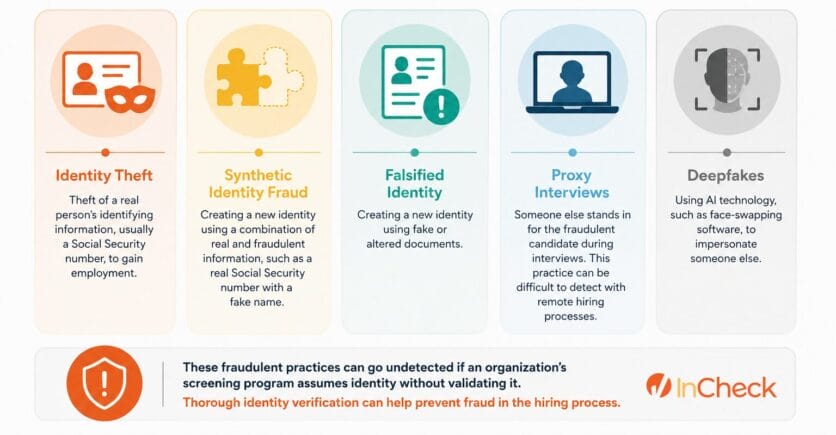
Identity fraud in hiring can take many forms. Some fraudulent methods have become more common, especially as artificial intelligence (AI) technology advances.
Here’s what employers should watch for when hiring:
How Often Does Employment Identity Fraud Occur?
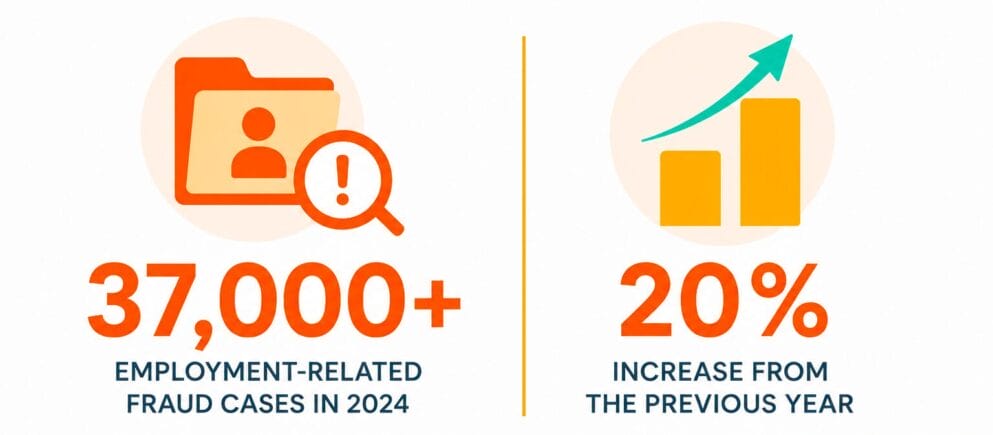
Employment identity fraud has become increasingly more common in recent years. The Federal Trade Commission reported over 37,000 employment-related fraud cases in 2024, the most recent year for which data was available. That number represents a 20% increase from the previous year.
The increase in employment fraud has created more risks for employers. At the same time, it’s also become harder to catch. The reasons that candidate fraud can go undetected include:
- More remote hiring: Virtual interviews and remote onboarding processes have made it easier for bad actors to misrepresent their identities.
- AI technology: New AI tools have enabled fake job applicants to use manipulation tactics, such as voice and video impersonation.
- High-volume hiring: When hiring managers need to fill positions quickly, they may prioritize speed over verification, missing essential screening steps that can root out candidate fraud.
To address these factors, HR and hiring teams need a comprehensive process for verifying identity early in the screening process.
How to Prevent Employment Identity Fraud
Despite rising cases of candidate fraud, there are ways employers can minimize this risk and avoid hiring fraudulent candidates. Follow these steps to implement employment fraud prevention for your organization:
Prioritize Identity-First Screening
Identity affects every part of the background check process. Verifying identity first can help you catch potential issues early, such as stolen identifiers or inconsistent information, before you get deeper into the hiring process.
Use Advanced Verification Methods
Traditional verification methods may no longer be enough to detect candidate fraud. Using advanced verification tools can add safeguards to protect your organization. These methods can include:
- Biometric verification
- Government ID validation
- Liveness-detected selfie matches
- Death Master File (DMF) checks, which check whether a Social Security number is linked to a deceased person
Implement Primary Source Verification
A complete fraud-resistant screening strategy should include primary source verification of a candidate’s education, employment, and credentials. Primary source verification means confirming information directly with a past employer, school, licensing board, or other reputable source. It can help spot diplomas or credentials that appear credible but are actually fake.
Review Screening for High-Risk Roles
Some positions, such as those in finance, healthcare, or safety-sensitive roles, involve greater risk and may require more comprehensive screening. Review your current policy to make sure you’re matching the screening level to the position’s risk level.
Train HR Teams on Red Flags
Provide training for recruiters and HR teams on identifying potential red flags. These may include:
- Inconsistent names, addresses, or contact details
- Reluctance to appear on camera for remote interviews
- Unverifiable employment, education, or credentials
- Unwillingness to complete a background check
Partner with a Fraud-Resistant Screening Provider
Work with a reputable screening partner to build an identity-first background check process. A fraud-resistant screening partner should balance speed and accuracy with thorough verification and compliance. Look for one that prioritizes identity verification, implements primary source verification, and offers tailored packages, and ask about their escalation protocols when inconsistencies do come up.
FAQs
How common is employment identity fraud?
Recently, identity fraud has become more common in hiring. Recent Federal Trade Commission data shows over 37,000 cases of employment-related fraud, which represents a 20% increase from the previous year.
How can employers spot identity fraud when hiring?
Some red flags can include inconsistencies in candidate information, such as address history or employment dates. Other signs to watch for include a reluctance to complete a background check, unverifiable education or employment, or unusual interview behavior.
What steps can employers take to prevent identity fraud in hiring?
First and foremost, employers should have a background screening program that begins with employment identity verification. They can partner with a fraud-resistant background check provider that offers multi-layered verification, which may include government ID validation, digital document verification, and Social Security number trace strategy.
Strengthen Your Pre-Employment Screening Process with InCheck
Employment identity fraud poses huge risks for employers, but there are ways you can work to prevent it. By prioritizing identity verification, credential validation, and HR training, your organization can take steps to minimize exposure and make hiring decisions with confidence.
Working with a credible screening partner can be another way to minimize the risk of employment fraud for your organization. At InCheck, we help employers build fraud-resistant screening programs to address the growing risks and complexities of candidate fraud. Our approach includes digital ID and document verification, SSN trace strategy, address and jurisdiction alignment, Death Master File checks, integrated I-9 and E-Verify solutions, and escalation protocols when fraud detection occurs. To learn more about building a stronger screening program to protect your organization, contact us today.